
Transfer/General Studies Division
The Transfer/General Studies Division is responsible for a diverse program of study that exposes students to a variety of disciplines. Within the division, the Communications, Liberal Arts, and Mathematics/Engineering/Sciences Divisions offer high-quality courses that develop the characteristics, knowledge and skills identified in the college’s statement of purpose and general education outcomes. The division ensures that courses meet the expectations of the Alabama Community College System, the Alabama General Studies Committee and all related accrediting agencies, and increases access to educational opportunities by offering courses in a variety of formats.
Division Outcomes
- Provide transferable general education courses that prepare students to succeed in upper-level programs of study.
- Provide transferable general education courses that fulfill the general studies requirements of the college’s Associate in Science, and Associate in Arts degrees.
- Provide developmental mathematics and English courses that prepare students to succeed in freshman- level courses.
Business/Information Systems Department
The Department of Business and Information Systems includes the areas of Accounting, Business, Computer Science, and Office Administration. The department provides all students access to quality educational opportunities and experiences that will meet the needs of an ever changing and increasingly demanding technological society. In addition, the department provides outstanding educational instruction, which prepares students for transfer to a college or university.
Division Outcomes
- Prepare graduates of career programs and professional degree programs that are in demand by employers.
- Prepare students to continue their education at four-year institutions.
- Prepare currently employed students with skill courses needed for job advancement.
- Evaluate/revise programs and courses to maintain relevancy.
Communications Department
The mission of the Communications Department is to develop in students a desire for excellence in scholarship, an ability to communicate effectively and an appreciation for the humanities. The department endorses the college’s Mission Statement and strives to uphold its commitment to learning.
Division Outcomes
- Provide quality instruction in developmental and transferable courses through emphasis on continued training and professional development for faculty.
- Prepare students to continue their education at four-year institutions or to enter the workforce.
- Offer courses that allow students to develop communication skills and knowledge for personal enrichment or for job advancement.
Liberal Arts Department
The mission of the Liberal Arts Department is to offer courses and programs that provide students a quality educational experience. The Liberal Arts Department is divided into two areas-Humanities and Social Sciences.
The Humanities area is dedicated to providing learning experiences in the liberal arts tradition by offering courses that present students the opportunity to pursue moral, creative, and philosophical interests. Courses within this area include art, music, religion, and philosophy. The Social Science area provides learning experiences in the liberal arts tradition by offering courses that present students the opportunity to develop self-awareness and an awareness of society and human nature. Courses within this area include anthropology, geography, history, political science, psychology, and sociology.
Division Outcomes
- Enable students, through various disciplines, to discover, develop and use their full range of abilities to better understand the world and their place in it.
- Provide students with a basic foundation of knowledge on which more advanced learning in the various disciplines and majors can later build.
- Enable students to reason and communicate clearly and to inquire deeply.
Mathematics/Engineering/Sciences Division
Biology Department
The mission of the Biology Department is consistent with the mission of Jefferson State Community College. The department provides biology courses that serve as a knowledge base for students majoring in science, allied health and non-science disciplines. Our teaching aims to help prepare students for their future professions both inside and outside of the scientific field and also to be a more informed member of their community, able to make responsible decisions in biological matters.
Division Outcomes
- Provide quality instruction in freshman and sophomore level courses in biology that transfer to senior institutions, and that lead to associate degrees.
- Prepare students with strong content knowledge in biology with emphasis on critical thinking and problem- solving skills.
- Advise students regarding choice of courses relevant to their academic major and/or senior institution.
Mathematics/Engineering/Physical Sciences Department
The Mathematics, Engineering, and Physical Sciences (MEP) Department's mission is to offer a broad range of courses that transfer to baccalaureate degree-granting institutions, service the career programs of the college, and prepare students for college-level mathematics courses while upholding the mission of Jefferson State Community College.
Department Goals
- Provide and monitor astronomy, chemistry, mathematics, physics, and physical science courses that emphasize critical thinking and analysis and that are transferable to institutions of higher learning.
- Provide and monitor developmental mathematics courses and courses relevant to the career and professional degree programs of the college.
- Provide and maintain quality teaching and learning environments for students and faculty in classrooms, laboratories, and offices.
- Enhance instruction to provide a positive learning experience for all students by employing the most up-to-date classroom technology and offering opportunities for faculty professional development.
- Provide preparation to students for college-level courses that depend on a knowledge of mathematics.
Nursing Education Program
The mission of the Nursing Education Program at Jefferson State Community College is as follows:
- To contribute to the continuing provision of health care in the community by offering quality associate degree and practical nursing programs.
- To provide the organization through which the philosophy, program objectives, curriculum and program policies may be developed, implemented, evaluated, and revised within the framework of the College’s organization in a manner which maintains approval by the Alabama Board of Nursing and accreditation by the Accreditation Commission for Education in Nursing (ACEN)
- To interpret the purposes of the Nursing Education Program to other institutions, organized groups, or individual members of the community.
- To promote an environment conducive to satisfaction and professionalism of the nurse faculty and staff.
The Mission/Philosophy of Nursing Programs of The Alabama College System
Mission – The mission of the nursing programs of the Alabama Community College System is to prepare graduates to practice safe, competent, patient- centered care in an increasingly complex and rapidly changing health care system. We seek to provide full and equal access to opportunities for educational success to meet the community needs.
Philosophy – We believe that nursing is a dynamic profession, blending science with the use of evidence-based practice and clinical reasoning and the art of caring and compassion to provide quality, patient-centered care. We believe learning is an interactive process in which faculty and students share responsibility to meet program outcomes. We believe in using educational methods that are current and supportive of students in the teaching and learning environment, with the presentation of information from simple to complex.
Nursing is guided by standards of practice and standards of professional performance. Standards reflect the values and priorities of the nursing profession. Therefore, we have integrated competencies from the Quality and Safety Education for Nurses (QSEN) and National League of Nursing (NLN) into our philosophy as part of our core values.
End of Program Student Learning Outcomes (EPSLOS) – NLN competencies for nursing are central to the conceptual framework. The related QSEN competencies for graduate nurses define the knowledge, skills and attitudes that the graduate nurse should possess to continuously improve the quality and safety of the healthcare systems within which they work. (QSEN)
Registered Nurse
- Human Flourishing – Advocate for patients and families in ways that promote their self-determination, integrity, and ongoing growth as human beings. (NLN def)
- Patient-Centered Care – Recognize the patient or designee as the source of control and full partner in providing compassionate and coordinated care based on respect for patient’s preferences, values and needs. (QSEN def)
- Nursing Judgment – Make judgments in practice, substantiated with evidence, that integrate nursing science in the provision of safe, quality care and that promote the health of patient within the family and community context. (NLN def)
- Safety – Minimizes risk of harm to patients and providers through both system effectiveness and individual performance. (QSEN def)
- Informatics – Use information and technology to communicate, manage knowledge, mitigate error, and support decision-making. (QSEN def)
- Professional Identity – Implement one’s role as a nurse in ways that reflect integrity, responsibility, ethical practices, and an evolving identity as a nurse committed to evidence-based practice, caring, advocacy, and safe, quality care for diverse patients within a family and community context. (NLN def)
- Teamwork and Collaboration – Function effectively within nursing and inter-professional teams, fostering open communication, mutual respect, and shared decision-making to achieve quality patient care. (QSEN def)
- Spirit of Inquiry – Examine the evidence that underlies clinical nursing practice to challenge the status quo, questions underlying assumptions, and offer new insights to improve the quality of care for patients, families, and communities. (NLN def)
- Evidence-based practice – Integrate best current evidence with clinical expertise and patient/family preferences and values for delivery of optimal health care. (QSEN def)
- Quality Improvement – Use data to monitor the outcomes of care processes and use improvement methods to design and test changes to continuously improve the quality and safety of health care systems. (QSEN def)
LPN
- Human Flourishing - Promote the human dignity, integrity, self-determination, and personal growth of patients, one self, and members of the healthcare team (NLN, 2010).
- Patient-Centered Care - Advocate for the patient and family in the provision of compassionate and coordinated care to support health, safety, and well-being of patients and families (QSEN, 2012).
- Nursing Judgement - Provide a rationale for judgments used in the provision of safe, quality care and for decisions that promote the health of patients within a family context (NLN, 2010).
- Informatics - Incorporate information and technology within own scope of practice to support safe processes of care (QSEN, 2012).
- Safety - Demonstrate the effective use of strategies to reduce risk of harm to self or others (QSEN, 2012).
- Professional Identity - Demonstrate awareness of good practice, boundaries of practice, and professional identity formation including knowledge and attitudes derived from self-understanding and empathy, ethical questions and choices that are gleaned from a situation, awareness of patient needs, and other contextual knowing (NLN, 2014).
- Teamwork and Collaboration - Function competently within own scope of practice as a member of the health care team (QSEN, 2012).
- Spirit of Inquiry - By collaborating with health care team members, utilize evidence, tradition, and patient preferences in predictable, patient care situations to promote optimal health status (NLN, 2014).
- Quality Improvement - Utilize various sources of information to review outcomes of care identifying potential areas for improvement of the quality and safety of care (QSEN, 2012).
- Evidence-Based Practice - Implement evidence-based practice in the provision of individualized health care (QSEN, 2012).
The conceptual framework derived from the philosophy forms a basis for the organization and structure of the nursing curriculum. This framework serves as a guide for nursing instruction in the attainment of student learning outcomes.
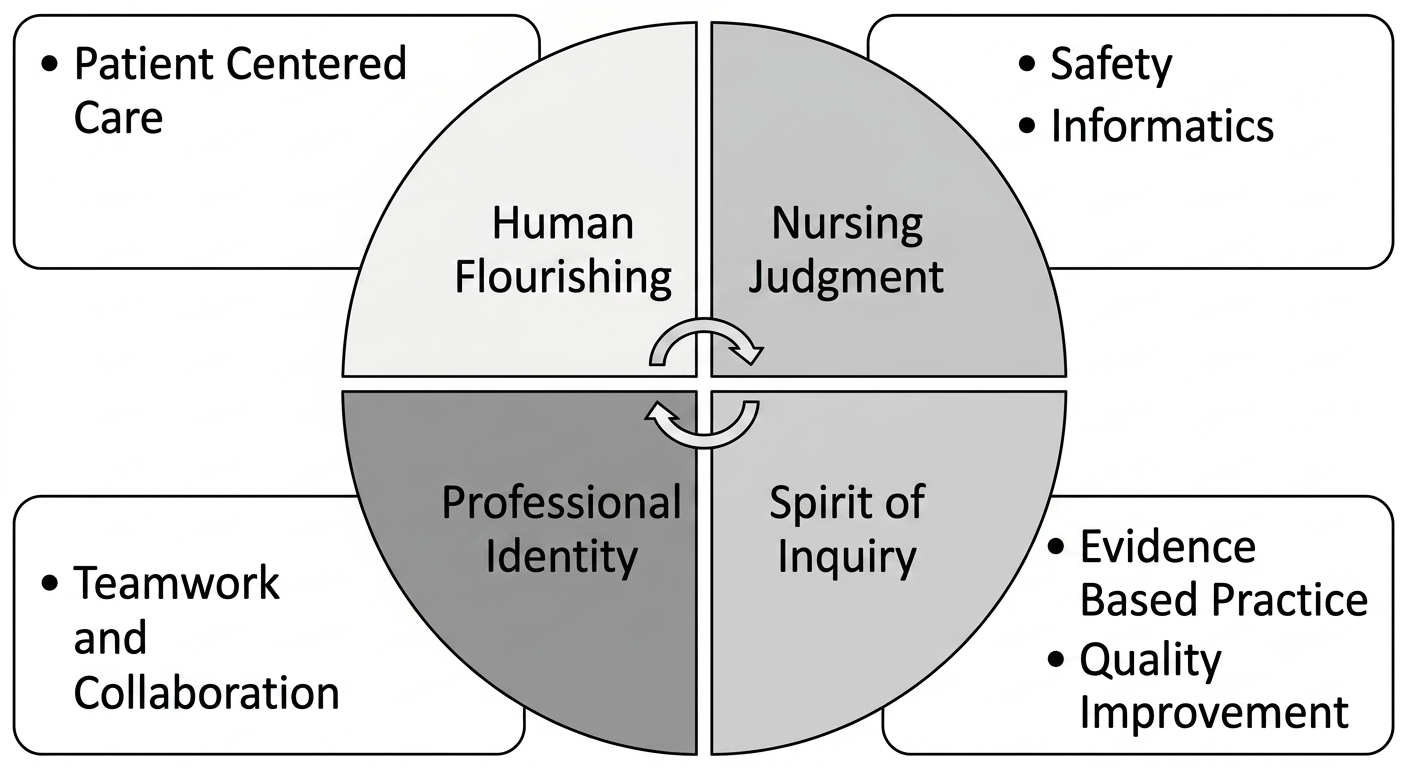
The framework consists of concepts that encompass the qualities of a successful graduate nurse. NLN competencies were chosen because they specifically define the competencies of the graduate Associate Degree Nurse. QSEN competencies reflect current contemporary\practice. Concepts interlace NLN and QSEN competencies to achieve the goal of providing graduate nurses with the tools needed to provide holistic care in an ever- changing health care delivery system. Each competency includes knowledge, skills and attitudes to serve as a basis for consistent performance expectations across academic and practice settings.
Health-Related Programs Division
The mission of the Health-Related Program (HRP) division is to provide quality academic instruction and clinical experiences to educate and graduate diverse, entry level, competent health related professionals. The HRP division is committed to offering programs and services that support the mission of the college and the needs of the community we serve.
The Health-Related Programs Division strives to:
- Provide relevant health-related programs, courses, and training opportunities that are designed to meet the educational and training needs of students and employers.
- Update curricula, laboratories, and technology as necessary to remain current with industry standards and to ensure that students are provided quality learning opportunities.
- Explore new teaching methodologies and delivery modes that may enhance student learning and expand access to educational offerings.
- Establish partnerships and maintain relationships with schools, colleges and universities, area hospitals, clinics, funeral homes, and other external groups.
- Provide quality advising and guidance to students to enhance student success.
- Maintain a professional and knowledgeable faculty.
- Maintain standards of excellence in programs’ content.
The following programs are offered: Diagnostic Medical Sonography, Histologic Technician; Medical Laboratory Technology, EMS/Paramedic, Funeral Service, Physical Therapist Assistant, Radiologic Technology Program, Respiratory Therapy, Surgical Technology, and Veterinary Technology (Distance Learning).
Center for Professional, Career, and Technical Education
The mission of the Center for Professional, Career, and Technical Education (CTE) is to provide high-quality and innovative educational programs and workforce training experiences designed to prepare students for entry or advancement in the workforce. CTE supports the mission of the college by aspiring to be the premiere higher education and training partner for communities and industries in the counties we serve.
The Center strives to:
- Cultivate collaborative partnerships with K-12, the community, business/industry, and other stakeholders in the areas we serve.
- Align curriculum seamlessly with industry standards, ensuring students receive a cutting- edge education and training experiences that resonate in the professional realm.
- Strategically address equipment and infrastructure needs, optimizing resources to create an innovative and conducive learning environment.
- Support comprehensive professional development opportunities for faculty, encouraging adoption of innovative teaching methodologies and relevant industry trends.
- Implement robust support systems and evidence-based retention strategies for students, creating an academic environment conducive to success and holistic growth.
The following programs are offered: Accounting, Banking and Finance, Biomedical Equipment Technology, Business Management, Child Development, Computer Information Systems Technology, Construction and Building Science Technology, Criminal Justice/Law Enforcement, Culinary and Hospitality Institute, Magic City FAME, Mechatronics, Office Administration Technology, and Welding Technology.
Distance Education Division
The Distance Education Division increases access to college courses by utilizing educational technologies and Internet based content delivery methods that reduce, and in some cases, eliminate, the need for students to be in particular locations at set times to receive instruction.
Division Outcomes
- Oversee development and design of transfer, career and developmental courses to ensure comparability of distance education courses with courses delivered in the traditional manner.
- Make effective and innovative use of educational hardware, software and web services to develop and deliver Internet, hybrid/blended and interactive videoconference courses.
- Schedule flexible learning opportunities that meet the needs of students with constraints that prevent them from attending traditional classes.
- Promote faculty development and training in the use of educational technologies and alternative methods of delivering instruction.
- Coordinate dual enrollment courses for qualified high school students.
Distance education courses follow the same course outlines as courses delivered in the traditional manner and are taught by qualified Jefferson State instructors. Upon successful completion of these courses, students receive credit equivalent to traditional courses.