
Jump to
- Statement of Academic Freedom
- Statement of Equal Opportunity
- Student Complaint Procedure
- Informal Resolution
- Formal Resolution
- Appeal to ACCS
- Retaliation Prohibited
- Americans with Disabilities Act of 1990
- Rehabilitation Act of 1973
- Harassment
- Sexual Harassment
- Definitions Relating to Sexual Harassment
Statement of Academic Freedom
Jefferson State subscribes to the following principles:
- Instructors are free to conduct independent research and to publish the results so long as the activities do not interfere with their assigned duties; however, research for pecuniary gain should not be undertaken without an understanding with the Vice President.
- In the classroom, instructors have full freedom to discuss their subjects. They should not introduce into their teaching irrelevant controversial matter. Within this limitation, the College protects the rights of both the students and instructors to a “free search for truth and its exposition.”
- The College respects the rights and privileges of instructors as citizens but believes that their positions impose special obligations. Hence, instructors are free from institutional censorship or discipline when they speak, write, or act as citizens; however, they should always remember that the public may judge the College by their words and behavior, and should therefore be accurate, exercise restraint, respect the opinions of others, and make it clear that they are not spokespersons for the institution.
Statement of Equal Opportunity
Jefferson State has filed with the Federal Government an Assurance of Compliance with all requirements imposed by or pursuant to Title VI of the Civil Rights Act of 1964 and the Regulations issued thereunder, to the end that no person in the United States shall, on the grounds of race, color or national origin, be excluded from participation in, be denied the benefits of, or be otherwise subjected to discrimination under any program or activity sponsored by this institution. It is the policy of Jefferson State Community College, a postsecondary institution under the control of the Alabama Community College System Board of Trustees, that no student, employee or applicant shall be discriminated against on the basis of any impermissible criterion or characteristic including, but not limited to, race, color, national origin, religion, marital status, disability, gender, age or any other protected class as defined by federal and state law.
The College will not retaliate against any person because they have engaged in a protected activity opposing the College or because they have made a complaint, testified, assisted, or participated in any manner in an investigation, proceeding or hearing alleging discrimination on a basis specified above.
Student Complaint Procedure
The following Student Complaint Procedure provides a mechanism for redressing both written and verbal allegations of unlawful discrimination at Jefferson State Community College. This procedure is not intended to cover complaints regarding sexual harassment. Complaints of sexual harassment should be filed under the college’s Title IX procedure. The college’s grievance procedure is composed of two steps: (1) Informal Resolution and (2) Formal Resolution.
Processing a complaint of discrimination shall begin with Informal Resolution. When complaints of discrimination are not resolved through Informal Resolution, however, the complaint may be further processed through Formal Resolution. The college will address all written and verbal complaints of discrimination. These procedures do not preclude anyone from filing a complaint of discrimination with an external agency.
Informal Resolution. Resolving a complaint internally, without conducting a formal investigation is the essence of the informal resolution process. This step consists of two components: (1) Investigation, and (2) Proposed Resolution. The investigation of a complaint of discrimination may include but is not limited to: (1) conferring with the complainant, the accused, supervisors and deans of the accused, other co-workers, and students; (2) examining of relevant documents, correspondence, and other material; and (3) interviewing other pertinent individuals, which may include individuals external to the college. Investigations at the informal step are conducted by those assigned by the president.
Attempts to resolve a complaint of discrimination may occur at any point during the investigation period, as authorized by the president. The president has the discretion to seek legal counsel in attempts to resolve complaints of discrimination.
Formal Resolution. The Formal Investigation is the second step in the college’s attempt to address and resolve complaints of discrimination. The Formal Resolution Step must be preceded by the Informal Resolution Step. The Hearing Step consists of six components: (1) additional investigation, if needed; (2) selection of hearing panel; (3) review of reports and other documents obtained from the Informal Resolution Step; (4) a formal hearing; (5) report of findings; and (6) decision. During the formal hearing, individuals may be placed under oath and their testimony may be recorded either by a professional court reporter or other recording device. The hearing will be held on the college’s campus and will be closed to the campus community, as well as to the public. A three- member hearing panel shall be appointed by the president to conduct the hearing. The panel shall consist of the appropriate administrator and two other members. The appropriate administrator shall serve as the presiding hearing officer; the president, however, shall have the discretion to appoint an outside party to serve as the hearing officer. The president or designee shall preside over any hearing that involves an administrator.
Informal Resolution
Any member of the college community who believes that he or she has been subjected to discrimination prohibited by Title VI of the Civil Rights Act of 1964, Title VII of the Civil Rights Act of 1964, Pregnancy Discrimination Act, Americans with Disabilities Act (ADA), or under section 504 of the Rehabilitation Act of 1973, may bring the matter to the attention of any academic or administrative officer, dean, associate dean, director, supervisor, or advisor. When a written or verbal complaint has been reported to any of these individuals, the recipient of the complaint will immediately forward the complaint to Human Resources. Complaints against students (student against student), may be forwarded to the Vice President for Student Affairs and Enrollment Management to be handled in accordance with the student disciplinary procedures outlined in the Catalog and Student Handbook.
Note: Students working under the College Federal Work/ Study program are not considered employees of Jefferson State, and therefore, should adhere to usual and customary student discipline procedures as outlined in the student handbook.
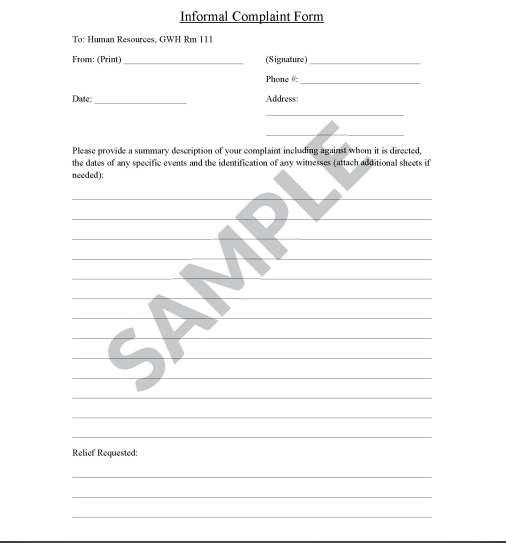
- The complainant should present the complaint as promptly as possible after the alleged discrimination occurs. Using the Informal Complaint Form, the complainant should submit a written statement of all allegations. The complaint must provide his/her name, address, and telephone number; the nature, date and description of the violation(s); the relief requested for corrective action; and any background information the complainant believes would be helpful. The complainant should sign and date the complaint. Upon receipt of the complaint, Human Resources will immediately notify the appropriate dean and the president.
- All complaints, both written and verbal, will be investigated by the appropriate person(s) immediately upon receipt, or immediately upon the college having obtained knowledge of the complaint.
- The intent of College policy is to resolve complaints of discrimination as quickly as possible. Except in extraordinary cases, informal complaints will be investigated and resolved within forty-five (45) business days of the date of actual receipt of said complaint by Human Resources. The date of receipt of a written complaint begins on the date that the complaint is actually filed with Human Resources. The date of receipt of a verbal complaint is the actual date that Human Resources obtained knowledge of the complaint.
- Every possible effort shall be made to ensure confidentiality of information received as part of the investigation to such extent as it does not compromise the college’s commitment to investigate allegations of discrimination. Complaints will be handled on a “need to know” basis with a view toward protecting the interests of both parties. Information resulting from the investigation should be discussed only with those individuals with a legitimate need to know.
- The complainant has the right to proceed with or to withdraw from the informal complaint procedure once it has begun. To withdraw a complaint, the complainant must submit a written statement requesting to withdraw the complaint. The request must be submitted to the president. If the complainant decides to terminate the informal process by withdrawing the complaint, it will not necessarily preclude further investigation and appropriate action by the college.
- The investigation record shall consist of statements from the complainant, the accused, witnesses, and others deemed by the investigator to have pertinent knowledge of the facts involved in the complaint.
- Results of the findings of the investigation will be reported to the complainant, the accused, appropriate administrator, and the president. After careful review of the investigation’s findings, the president, appropriate administrator, and Human Resources shall determine an appropriate responsive action.
- The complainant and the accused will be notified of the results of the Informal Resolution by appropriate means. A copy of the results will become part of the investigation record.
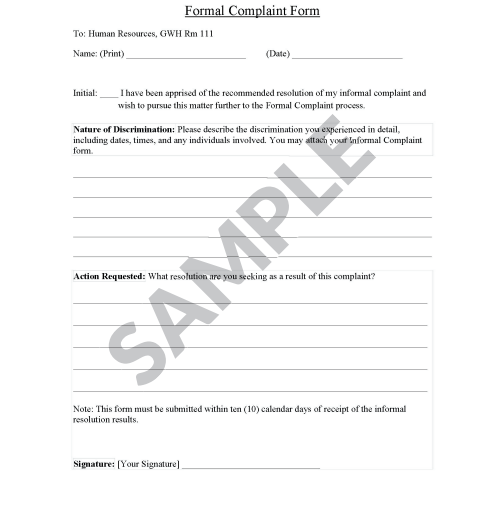
- If the results of the informal resolution of the complaint are not accepted by the complainant and he or she desires further action, then the complainant may proceed to the Formal Resolution as outlined below. To do so, the complainant must file, with Human Resources, Formal Complaint form. This form must be completed in its entirety and returned to Human Resources within ten (10) calendar days of the date of notification of informal resolution. If the complainant does not proceed to Formal Resolution, then he or she will be deemed to have accepted the results of the investigation and informal resolution.
- Appropriate disciplinary actions may be taken against individuals who file malicious charges. A failure to substantiate a charge of discrimination does not automatically constitute a malicious charge. Repeated filings of frivolous complaints may be considered a malicious action.
Formal Resolution
If the complaint cannot be resolved by Informal Resolution, the complainant may proceed to Formal Resolution by filing a Formal Complaint form with Human Resources within ten (10) calendar days of the date of notification of the informal resolution results. The complainant has the right to proceed with or to withdraw from the procedure once it has been submitted. To withdraw a complaint, the complainant must submit a written statement requesting to withdraw the complaint. The issues involved in the complaint should not be changed once the charge has been made, provided, however that the complaint may be revised to address issues arising during the investigation, which were not known to the complainant or to the college when the initial complaint was filed.
All participants involved in the formal hearing process shall maintain confidentiality to the greatest extent possible. Any additional investigation required during this stage shall be conducted by Human Resources and/or others as assigned by the president.
- Human Resources will: (1) receive and distribute the Formal Complaint form to the President and the accused; (2) assist with any additional investigation that may be required; (3) maintain permanent records relevant to the hearing; (4) notify all witnesses to appear at the hearing; (5) coordinate the hearing activities; (6) secure a court reporter, if necessary; (7) other duties as assigned by the president.
- The complainant, as well as the accused, shall be permitted to have an attorney present during the hearing. Attorneys representing either party, however, shall not be allowed to participate directly in the hearing, but may offer advice to their respective clients.
- The Hearing Step shall include the following, and all parties shall adhere to the time constraints as set forth:
- Following receipt of the Formal Complaint form, the president will appoint a hearing panel.
- The hearing panel will have thirty (30) working days following date of receipt of Formal Complaint form, to conduct any additional investigation, study the complainant’s allegations, hold a formal hearing, and make a written report of findings and, if directed, recommendation(s)to the president.
- The president will have thirty (30) calendar days following date of receipt of the hearing panel’s report to make a final decision on the matters addressed by the hearing panel. The president’s decision will be delivered to the complainant and the accused by certified mail, hand delivery, or other suitable means.
Appeal to ACCS
If, after exhausting all available institutional processes, a student’s complaint remains unresolved, the student may appeal to the Alabama Community College System using the System’s official Student Complaint Form or Online Student Complaint Form, each found on the ACCS website at www.accs.edu/student-complaints/. Students may submit completed complaint forms using one of the following options:
- Printing the form, signing it, and then either (1) scanning it and emailing it to complaints@accs.edu or (2) mailing it to: Alabama Community College System Attention: Division of Academic and Student Affairs P.O. Box 302130 Montgomery, AL 36130-2130
- Electronically submitting the form using the Online Student Complaint Form found on the ACCS website at www.accs.edu/student-complaints
The Division of Student Success will investigate the complaint.
The institution which is the subject of complaint has 15 days to provide a written response to questions and/or concerns raised during the investigation. Such response may or may not contain a resolution.
The Division of Student Success will adjudicate the matter within 30 business days of receipt of complaint and write a report or letter to the institution and student detailing corrective action, if any is necessary, or stating that the school has no violation of policies.
If corrective action is needed the institution will have 30 days to comply or develop a plan to comply with the corrective action.
The System Office will monitor the institution’s compliance to ensure the completion of any required corrective action. The decision made by ACCS is final and cannot be appealed.
The intent of Jefferson State Community College policy is to provide for prompt and thorough investigation of all complaints. The time limits set forth within the guidelines are subject to change at the discretion of the president to ensure a satisfactory conclusion to the investigation.
Retaliation Prohibited
Retaliation against a student or employee for bringing a complaint of discrimination is prohibited. Such action shall be regarded as a separate and distinct cause for complaint. Retaliation is itself a violation of college policy and may be grounds for disciplinary action.
NOTE: If the last day for filing a notice of appeal falls on either Saturday, Sunday, or a legal holiday, complainant will have until the close of normal business hours of the college on the first working day following the fifteenth calendar day to file.
Amended April 25, 2024
Americans with Disabilities Act of 1990
Jefferson State complies with the provisions of the Americans with Disabilities Act, which makes it illegal to discriminate against individuals with disabilities in employment, public accommodations, public services, transportation, and telecommunications.
Title II of the Americans With Disabilities Act states, in part, that “no qualified individual with a disability shall, by reason of such disability, be excluded from participation in or be denied the benefits of the services, programs, or activities of a public entity, or be subjected to discrimination by any such entity.”
The College will provide reasonable accommodations for individuals with documented disabilities. To initiate a request for accommodations, employees should contact their supervisors, and students should contact the ADA Accommodations Office located in the Fitzgerald Student Center 300 at the Jefferson Campus, or the General Studies Building 120 at the Shelby-Hoover Campus. The ADA Accommodations Office staff will interview all students requesting accommodations, review all documentation submitted, and will make a decision on the validity of the request for accommodations. Contact Scotty Rainwater, ADA Director, at (205) 856-6077 or ada@jeffersonstate.edu.
Rehabilitation Act of 1973
Jefferson State offers equal opportunity in its employment, admissions and educational programs and activities in compliance with Section 504 of the Rehabilitation Act of 1973.
Harassment
It is the policy of Jefferson State Community College that employees and students be provided a workplace and academic atmosphere free of harassment in any form. Such harassment is a violation of the Alabama Community College System Board of Trustees. Any practice or behavior that constitutes harassment or discrimination shall not be tolerated on any campus or site, or in any division or department by any employee, student, agent or non-employee on college property and while engaged in any institutionally sponsored activities.
It is within this commitment of providing a harassment-free environment and in keeping with the efforts to establish an employment and educational environment in which the dignity and worth of members of the college community are respected, that harassment of students and employees is unacceptable conduct and shall not be tolerated at Jefferson State Community College.
A nondiscriminatory environment is essential to the mission of Jefferson State Community College. A sexually abusive environment inhibits, if not prevents, the harassed individual from performing responsibilities as a student or employee. It is essential that institutions maintain an environment that affords equal protection against discrimination, including sexual harassment. Jefferson State Community College will take all steps necessary to ensure that harassment, in any form, does not occur. Employees and students who are found in violation of this policy shall be subject to discipline, up to and including termination, as appropriate to the severity of the offense. Employees and students of Jefferson State Community College shall strive to promote a college environment that fosters personal integrity where the worth and dignity of each human being is realized, where democratic principles are promoted, and where efforts are made to assist colleagues and students to realize their full potential as worthy and effective members of society. Administrators, professional staff, faculty, and support staff shall adhere to the highest ethical standards to ensure a professionally functioning institution and to guarantee equal educational opportunities for all students.
Harassment can be defined as but is not limited to:
- Disturbing conduct which is repetitive;
- Threatening conduct;
- Intimidating conduct;
- Inappropriate or offensive slurs, jokes, language, or other verbal, graphic, or other like conduct;
- Unwelcome sexual advances, requests for sexual favors, or sexual based offenses;
- Assault;
- Repeated contact solicited during non-traditional business hours, which may be perceived as harassment by recipient unless it is specifically associated with work related duties.
Harassment of employees or students by non-employees is also a violation of this policy.
Any employee who becomes aware of any such harassment shall report the incident(s) to his or her supervisor, Human Resources, or an appropriate college official. In response to every complaint, Jefferson State Community College will take prompt investigatory actions and corrective and preventative actions where necessary. An employee or student who brings such a complaint to the attention of Jefferson State Community College in good faith will not be adversely affected as a result of reporting the harassment.
This policy encourages faculty, students, and employees who believe they have been the victims of harassment to contact the Jefferson State Community College Title IX Coordinator, Human Resources Director, or President at the institution within ten (10) days of the occurrence of the alleged incident. Any reprisals shall be reported immediately to the Title IX Coordinator, Human Resources Director, or President.
Sexual Harassment
As required by Title IX of the Education Amendments of 1972, the College does not discriminate on the basis of sex in its education programs and activities. This includes discrimination affecting employees of the college and applicants for employment, students and applicants for admission, or members of the public. All members of the College community are expected to conduct themselves in a manner that does not infringe upon the rights of others, whether on college premises or at any College owned off campus location and while participating in any educational program or activity of the College.
Sexual harassment, which includes sexual misconduct and sexual assault, is a form of sex discrimination, which is prohibited under Title IX of the Education Amendments of 1972 and the Violence Against Women Act. This policy is intended to reaffirm the College’s commitment to address sexual harassment and take steps to prevent its reoccurrence and preserve or restore equal access to the College’s education programs and activities. Dating violence, domestic violence, and stalking may also be considered forms of sexual discrimination. Due to the seriousness of these offenses, the College has adopted specific policies and procedures, outlined in this Student Handbook, employment policies, and https://www.jeffersonstate.edu/titleix to address alleged instances of sexual harassment, sexual misconduct, sexual assault, dating violence, domestic violence, and stalking. The College believes that no person should bear the effects of sexual harassment alone. When such conduct occurs, the College’s paramount concern is for the safety and well-being of those impacted. To support and assist students, the College provides a range of resources that include a trained counselor.
Under Title IX, individuals reporting allegations related to sexual harassment and/or sexual violence, have the right to a resolution of their complaint, to have the college conduct a prompt, thorough and impartial investigation, and to receive supportive measures to ensure the safety and wellbeing of the individuals involved and the college community.
When allegations of sexual harassment and/or sexual violence in any form are brought to the attention of the Title IX Coordinator, and if a responding party is found to have violated this policy, serious sanctions will be used to prevent its reoccurrence. Jefferson State Community College does not tolerate or condone retaliation. Individuals wishing to report reporting sexual harassment and/or sexual violence and/or to make inquiries concerning the application of Title IX at the College may contact:
Ms. Jennifer Daniel, Director of Human Resources
Title IX Coordinator (Employees)
111 George Wallace Hall
2601 Carson Road
Birmingham, Alabama 35215
Phone: (205) 856-8598
Email: jennifer.daniel@jeffersonstate.edu
and/or
Amanda Harbison, Vice President for Student Affairs
and Enrollment Management
Title IX Coordinator (Students)
207 James B. Allen Library
2601 Carson Road
Birmingham, Alabama 35215
Phone: (205) 856-7991
Email: amanda.harbison@jeffersonstate.edu
and/or
Assistant Secretary
U.S. Department of Education
Office for Civil Rights
Lyndon Baines Johnson Department of Education Building
400 Maryland Avenue, SW
Washington, DC 20202-1100
Telephone: (800) 421-3481
Fax: (202) 453-6012; TDD: (800) 877-8339
Email: OCR@ed.gov
Information regarding the Title IX Coordinator and their role will be provided to all faculty, staff, students, applicants for admissions, and applicants for employment. Also, this information is available on the College website https://www.jeffersonstate.edu/titleix under the Title IX webpage.
The U.S. Department of Education’s Office for Civil Rights (OCR) enforces, among other statutes, Title IX of the Education Amendments of 1972. Title IX protects people from discrimination based on sex in education programs or activities that receive Federal financial assistance. Title IX states that: “No person in the United States shall, on the basis of sex, be excluded from participation in, be denied the benefits of, or be subjected to discrimination under any education program or activity receiving Federal financial assistance.”
Definitions Relating to Sexual Harassment
Many terms are used in the context of sexual harassment. The following will provide some common definitions and examples.
Actual knowledge: The notice of sexual harassment or allegations of sexual harassment to the Title IX Coordinator or any official of the College who has authority to institute corrective measures of behalf of the College shall be deemed actual knowledge on the part of the College.
Complainant: is an individual who is alleged to be the victim of conduct that could constitute sexual harassment. For the purposes of this procedure a Complainant may be an individual applying for admission or employment, an employee, a student or an individual otherwise participating in or attempting to participate in the College’s education programs and activities.
Respondent: is an individual who has been reported to be the perpetrator of conduct that could constitute sexual harassment.
Formal complaint: is a document filed by the complainant or signed by the Title IX Coordinator alleging sexual harassment against a respondent and requesting that the College investigate the allegation of sexual harassment. Note: At the time of filing a formal complaint, a complainant must be participating in or attempting to participate in an educational program or activity of the College at which the formal complaint is filed.
Consent: “Consent” must be informed, voluntary, and mutual and can be withdrawn at any time. There is no consent when there is force, expressed or implied, or when coercion, intimidation, threats, or duress is used. Whether or not a person has taken advantage of a position of influence over another person may be a factor in determining consent. Silence or absence of resistance does not imply consent. Past consent to sexual activity with another person does not imply ongoing future consent with that person or consent to that same sexual activity with another person.
Incapacitation: An individual who is incapacitated is unable to give consent to sexual contact. States of incapacitation include sleep, unconsciousness, intermittent consciousness, intoxication, or any other state where the individual is unaware that sexual contact is occurring or is otherwise unable to give informed and voluntarily consent. Incapacitation may also exist because of a mental or developmental disability that impairs the ability to consent to sexual contact. Example: A person who is taking pain medication and falls asleep under the influence of the medication can be incapacitated and not be able to give consent to sexual contact.
Sexual Misconduct: Committing sexual abuse, sexual assault, sexual harassment, sexual exploitation, or statutory rape, as defined below or under Alabama state law.
Harassment: The striking, shoving, kicking, or otherwise touching or making physical contact in regard to another for the purpose of harassing, annoying or alarming; and/or directing abusive or obscene language or making an obscene gesture toward someone for the purpose of harassing, annoying, or alarming. Example: Making or using persistent derogatory comments, epithets, or slurs that place a person in a hostile or fearful environment or where the person’s safety is in jeopardy.
Sexual harassment: Conduct on the basis of sex that satisfies one or more of the following:
- A school employee conditioning education benefits on participating in unwelcome sexual conduct (i.e. quid pro quo);
- Unwelcomed conduct that a reasonable person would determine is so severe, pervasive, and objectively offensive that it effectively denies a person equal access to the school’s education program or activity; or
- Stalking, dating violence, or domestic violence.
Definitions of Sexually Based Offenses
Domestic Violence:
Includes felony or misdemeanor crimes of violence committed by a current or former spouse of the victim, by a person with whom the victim shares a child in common, by a person cohabitating with or has cohabitated with the victim as a spouse, or by any other person against an adult or youth victim who is protected from that person’s acts under the domestic or family violence laws of the jurisdiction (34 U.S.C.12291(a)(8).
In Alabama, domestic violence includes felony and misdemeanor crimes of violence committed by a current or former spouse, parent, child, any person with whom the defendant has a child in common, a present or former household member, or a person who has or had a dating or engagement relationship with the defendant (Alabama Code Section 13A, Article 7 Domestic Violence in 1st, 2nd, and 3rd Degrees).
Dating Violence: Means violence committed by a person:
1. Who is or has been in a social relationship of a romantic or intimate nature with the victim; and
2. Where the existence of such a relationship will be determined factors: based on a consideration of the following
- the length of the relationship,
- the type of relationship,
the frequency of interaction between the persons involved in the relationship (34 U.S.C.12291(a) (10).
In Alabama, dating violence is covered under Alabama Code Section 13A, Article 7 Domestic Violence in 1st, 2nd, and 3rd Degrees.
Stalking: Means engaging in a course of conduct directed at a specific person that would cause a reasonable person to a) fear for his or her safety or the safety of others; or b) suffer substantial emotional distress 34 U.S.C.12291(a)(30).
In Alabama, stalking is when a person intentionally and repeatedly follows or harasses another person and who makes a threat, either expressed or implied, with the intent to place that person in reasonable fear of death or serious bodily harm (13A-6-90 Stalking in the first degree) or a person who, acting with an improper purpose, intentionally and repeatedly follows, harasses, telephones, or initiates communication, verbally, electronically, or otherwise, with another person, any member of the other person’s immediate family, or any third party with whom the other person is acquainted, and causes material harm to the mental or emotional health of the other person, or causes such person to reasonably fear that his or her employment, business, or career is threatened, and the perpetrator was previously informed to cease that conduct (Section 13A-6-91 Stalking in the second degree).
Sexual Assault: Means an offense classified as a forcible or non-forcible sex offense under the uniform crime reporting systems of the Federal Bureau of Investigation 20 U.S.C.1092 (f)(6)(A)(v).
Victims Option to Report
Students and employees who are victims of crime including rape, acquaintance rape, domestic violence, dating violence, sexual assault, or stalking, are encouraged by the College to report but do have the option not to report the incident to campus law enforcement, or local law enforcement. In those cases, the victim may still seek assistance confidentially from the following agencies or any other victim service agency of his/her choosing:
Resources for Sexual Assault Victims in Jefferson County and St. Clair County
Birmingham Crisis Center (Rape Response) is available for victims of sexual abuse 24 hours a day, 7 days a week. Services provided by Rape Response include mental health counseling and evidence collection. Services are available to victims whether or not the victim decides to contact law enforcement. All services are free and confidential.
Phone number: (205) 323-7777
Address: 3600 8th Avenue South, Birmingham, Alabama 35222
Resources for Sexual Assault Victims in Shelby County and Chilton County
Safe Shelby (Rape Response) is available for victims of sexual abuse 24 hours a day, 7 days a week. Services provided by Rape Response include mental health counseling and evidence collection. Services are available to victims whether or not the victim decides to contact law enforcement. All services are free and confidential.
Phone number: (205) 669-7233
Address: P.O. Box 620 Columbiana, Alabama 35051